HOME>Updates
Phoenix Media's president: Human editors, authors still key to publishing in AI era
(en.ppm.cn)
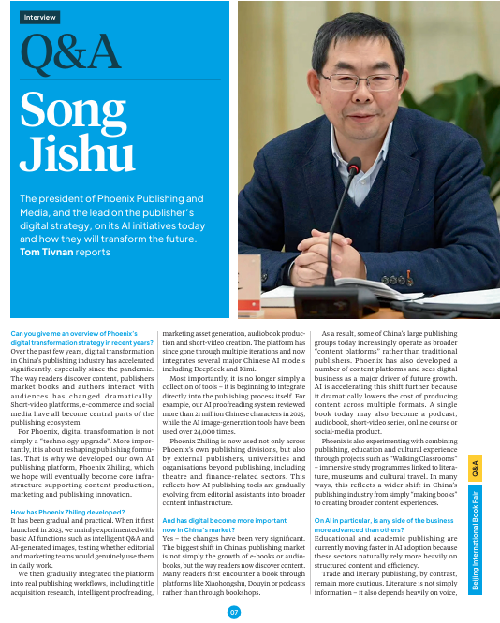
Interview with Song Jishu, president of Phoenix Publishing and Media Group, is featured in The Bookseller's special edition.
Song Jishu, president of Phoenix Publishing and Media Group, has said that artificial intelligence is reshaping the content ecosystem and talent structure in the publishing sector, but in AI era, human editors and authors remain the heart of publishing.
Song made the remarks during an interview with British publishing magazine The Bookseller during the 2026 Beijing International Book Fair, which took place from June 17 to 21. He detailed Phoenix Media's digital transformation in the AI era, emphasizing that the company is using AI and digital tools to enhance the efficiency of content production while creating new reading and knowledge consumption scenarios.
Song highlighted Phoenix Zhiling, the AI publishing platform Phoenix Media has developed, saying that it is hoped to become core infrastructure supporting content production, marketing and publishing innovation.
He said that the development of Phoenix Zhiling has been gradual and practical. "When it first launched in 2023, we mainly experimented with basic AI functions such as intelligent Q&A and AI-generated images, testing whether editorial and marketing teams would actually use them in daily work," he said.
The platform is then gradually integrated into real publishing workflows, including title acquisition research, intelligent proofreading, marketing asset generation, audiobook production and short-video creation. It has since gone through multiple iterations and now integrates several major Chinese AI models including DeepSeek and Kimi, according to Song.
The platform is now used not only across Phoenix Media's own publishing divisions, but also by external publishers, universities and organizations beyond publishing, including theater and finance-related sectors, Song said, adding that this reflects how AI publishing tools are gradually evolving from editorial assistants into broader content infrastructure.
Song highlighted significant changes in China's publishing market, saying that the biggest shift is not simply the growth of e-books or audiobooks, but the way readers now discover content. Many readers first encounter a book through platforms like Xiaohongshu, Douyin or podcasts rather than through bookshops.
He said that Phoenix Media is experimenting with combining publishing, education and cultural experiences through projects such as "Walking Classrooms" — immersive study tours linked to literature, museums and cultural travel. In educational and academic publishing, AI is particularly useful for textbook analysis, courseware generation, and the development of knowledge services.
On the copyright issue, Song noted the industry's generally positive attitude, though AI-generated content's copyright boundaries remain unclear.
He stressed that the biggest challenge is not the models themselves but the transformation of data, processes, and talent. Future editors will need content judgment skills and an understanding of AI tools, data and content operation logic, he said.
Song envisioned AI becoming foundational to the publishing industry in the coming years, but highlighted that human editors and authors remain the heart of publishing.
This interview features in The Bookseller's special edition during BIBF, showcasing the strategic thinking and exploratory practices of a leading Chinese publisher in the AI era.
-

Symbols of Jiangsu (Pocket Edition)
Non-FictionSymbols of Jiangsu (Pocket Edition) selects the most representative and symbolic Jiangsu special cultural resources.
-
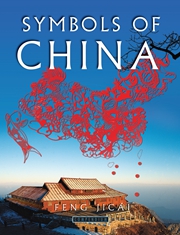
Symbols of China
Humanities & Social Science; Non-FictionSymbols of China examines those things that make China Chinese.